impoverished spouse when spouse dies what happens to that income
Despite increased labor strength participation rates among women and reforms under the Employee Retirement Income Security Act, widowhood remains an important risk factor for transition into poverty, although somewhat less then than 20 years ago. Women widowed at younger ages are at greatest take chances for economic hardship after widowhood, and their situation declines with the duration of widowhood. Nosotros besides find that women in households that are least prepared financially for widowhood are at greatest hazard of a husband's death, considering of the strong human relationship between mortality and wealth.
Purvi Sevak is an Assistant Professor of Economics in the Department of Economics, Hunter College, City University of New York; David R. Weir is Research Professor and Acquaintance Managing director of the Survey Research Eye of the Institute for Social Inquiry and Assistant Director of the Wellness and Retirement Report at the University of Michigan; and Robert J. Willis is Professor of Economics and Research Professor in the Survey Research Middle and the Population Studies Eye of the Plant for Social Research and the Chief Investigator for the Health and Retirement Study at the University of Michigan.
Acknowledgments: This work was supported by a grant from the Social Security Assistants through the Michigan Retirement Research Center (Grant No. ten-P-98358-5). The findings and conclusions are solely those of the authors and should not exist considered every bit representing the views of the Social Security Administration or any agency of the federal government. This article was previously published by the University of Michigan Retirement Enquiry Center, Ann Arbor, as "The Economic Consequences of Widowhood," Working Paper WP 2002-023, April 2002, nether the project "The Impact of Widowhood on the Economic Status of Women," Project No. UM99-05.
The findings and conclusions presented in the Message are those of the authors and do not necessarily represent the views of the Social Security Assistants.
Summary
Households headed by elderly women still experience essentially higher rates of poverty than practice other households. In this article, we use longitudinal data from the Wellness and Retirement Study to examine why widowed women are so much more than probable than married women to accept poor economical condition, when they themselves were in one case married. Nosotros examine whether high rates of poverty are due to income lost upon a husband's decease, to depletion of assets, or to selection effects. Although nosotros find that widowhood does increment the incidence of poverty amongst women who were not poor when married, the substantial number of widows in poverty reflects poor economic status that continued from marriage to widowhood. Poor women are more likely to become widowed at a immature age, because of the relationship between mortality and socioeconomic status.
The findings in this article provide a brighter outlook for widows than practice studies of widows in earlier decades. In the 1970s, 37 per centum of new widows became poor afterward widowhood. By the 1990s, this rate had fallen to between 12 pct and 15 percent. Still, widowhood remains an of import adventure gene for transition into poverty. Faced with the loss of resource in widowhood, women have only a few options available to improve their economic status. Remarriage is difficult because of the demographic imbalances acquired by shorter male life expectancy. We find some evidence that widows alive with children or siblings so that they can be function of a household with more than resources. Although earning income through piece of work is the main way women can amend their status, it becomes increasingly difficult to achieve with historic period, and nosotros cite piffling evidence of it in our article.
Women who are to the lowest degree able to prepare for widowhood and therefore are at greatest gamble of widowhood, because of the relationship between mortality and wealth, requite cause for Social Security policy to remain attentive to the special situation of widows. We would suggest that additional attention be paid to the welfare of women widowed afterwards their children have grown but earlier they have completed their retirement preparations. These women are generally not eligible for Temporary Assistance for Needy Families, Supplemental Security Income, or Social Security and thus are virtually vulnerable to poverty. Fifty-fifty women who have some accumulated wealth are more than probable to be in poverty many years afterward, equally they are forced to spend down their wealth in the years before gaining Social Security eligibility.
Introduction
High rates of poverty among widows, especially those living lonely, remain a primary business organization of policies for the elderly (Burkhauser 1994; Sandell and Iams 1997). Expansion of Social Security and Supplemental Security Income, women's increasing educational attainment and labor force participation rates, and changes in policies regulating employer-provided alimony plans should accept improved the economic condition of women during the past few decades. Nevertheless, households headed by elderly women still experience substantially college rates of poverty than do other households. In this article, we utilise the Health and Retirement Study (HRS) to examine the economic status of older, widowed women in the 1990s.
Several main determinants of a widow's economic condition take been discussed in the literature (Zick and Smith 1991), such equally economic preparedness of intact married couples for potential widowhood, expenses associated with a husband'due south death, and declining economic condition associated with the elapsing of widowhood. We evaluated the offset component in previous piece of work, using the baseline 1992 wave of the Health and Retirement Report (Weir and Willis 2000). Using measures of total wealth (divers here as financial assets plus pensions and Social Security) of married couples and the amount of full wealth that would remain for a widow if the husband died immediately following the interview date, we found considerable variation in the provision for widows, holding constant the resources of the marriage.
This article tackles the get-go and third components of the economic status of widows using income and wealth data from the cross-sectional and the longitudinal aspects of the HRS and the report of Asset and Health Dynamics Amongst the Oldest Old (AHEAD). We besides examine a quaternary determinant of economic status: choice effects that brand widowhood more than likely for women who have fewer economical resources. We find that i of the reasons poverty rates amid widows are essentially higher than poverty rates among married women is that poorer married women are more than likely to get widowed.
In this article, we
- discuss the HRS data;
- compare measures in the HRS to those in the Current Population Survey (CPS), which has been the primary information set used to study poverty amongst the elderly;
- examine how assets and dissimilar components of income alter over time amongst women with different marital status changes;
- try to uncrease the relationship between higher rates of poverty and duration of widowhood; and
- study the relationship between income and bloodshed risk to assess the extent to which loftier rates of poverty amongst widows are due to choice effects.
Information
The data used in this article are from the 1992 to 1998 waves of the Health and Retirement Study. The HRS merged ii data sets: the original HRS, which beginning collected data in 1992 on individuals born betwixt 1931 and 1941, and the Ahead study, which starting time nerveless data in 1993 on individuals born before 1924. In 1998, the two original studies were combined, and ii new cohorts were added to produce a cantankerous-exclusive sample that is representative of the U.South. population built-in in the years up to 1947 (that is, people aged 51 or older in 1998).
Much of the existing literature on elderly poverty uses data from the March Electric current Population Survey. Pooled cross sections of the CPS tin be used to runway trends over time, since the CPS has been collected annually for many years and the survey measures accept not changed much from year to year. One of the goals of this article is to illustrate how the HRS tin can add to the written report of poverty and to other measures of economic well-being amidst elderly households undergoing transitions in family structure.
Unlike the CPS, the HRS reinterviews its sample members every 2 years until the respondent'southward death. Thus, a longitudinal data set tin exist synthetic to direct examine whether and why widowhood is associated with higher rates of poverty and how economic status evolves over the duration of widowhood. The 1998 wave plus the first two waves (1992 and 1994) of the original HRS (that is, persons born between 1931 and 1941) and the outset two waves (1993 and 1995) of the AHEAD report (persons born earlier 1924) are combined to conduct the longitudinal analyses in this article. The total 1998 sample of individuals anile 51 and older is used to nowadays the cantankerous-sectional analyses for 1998.
The HRS elicits detailed information on assets, pensions, housing, insurance, and Social Security eligibility, in addition to information about income. Other studies of widowhood have had to focus more narrowly on current income, thereby neglecting the full potential to support lifetime consumption and frequently producing the advent of volatile movements into and out of poverty (Bound and others 1991; McGarry 1995). The HRS can be used to replicate conventional income-based definitions of poverty, only it can also exist used to study the long-term implications of changes in marital status on wealth. In the next section, nosotros replicate CPS-based measures of poverty with the HRS to assess whether measures in the HRS are comparable with those in the CPS.
Widows' Wealth, Income, and Poverty, 1992–1998
HRS and AHEAD poverty rates among women for selected years are compared with CPS rates in Tables 1 and two. Overall, estimates of poverty from the HRS 1998 cross section are slightly lower than like estimates from the CPS (10.9 per centum vs. 12.2 percent for all women) in Tabular array i. This is nigh probable due to slight improvements in the HRS survey pattern compared with the design of the CPS. For case, missing data are a perennial problem for which the HRS uses a series of structured questions called unfolding brackets to place a range for the true value and greatly reduce the error from imputations. Thus, respondents in the HRS may more fully report their income from dissimilar sources. An additional difference between the studies is that the HRS treats unmarried couples who report they live together "equally if married" equally a single financial unit, thereby combining the incomes of both partners. The CPS, however, does non indicate whether two unrelated people have a shared financial human relationship. Still, since the gap between the poverty estimates exists even for married women, this is not probable to be the sole factor driving the different estimates.1
| Historic period in survey year | All women in survey | Married | Divorced or separated | Widowed | Never married |
|---|---|---|---|---|---|
| Health and Retirement Report | |||||
| All | ten.9 | 3.9 | 19.7 | 17.3 | 26.ii |
| 51–64 | 9.4 | 4.5 | 16.five | xix.6 | 22.iii |
| 65–79 | 10.3 | 2.8 | 26.0 | 14.5 | 26.vi |
| fourscore or older | nineteen.0 | 4.0 | 33.3 | 20.3 | 41.1 |
| Current Population Survey | |||||
| All | 12.2 | 5.6 | 22.1 | 18.6 | 21.4 |
| 51–64 | 11.0 | 5.5 | 21.5 | 21.4 | 22.viii |
| 65–79 | 12.two | five.five | 23.nine | 17.2 | 21.5 |
| 80 or older | xvi.half dozen | 7.5 | 21.0 | 19.one | xvi.2 |
| SOURCE: Author'south calculations using data from 1998 from the Health and Retirement Study and the Current Population Survey. | |||||
| Survey twelvemonth | Age | All women in survey | Married | Divorced or separated | Widowed | Never married |
|---|---|---|---|---|---|---|
| Wellness and Retirement Study Panel, 1992–1998 | ||||||
| 1992 | 51–61 | ten.3 | 4.9 | 21.6 | 21.5 | 21.1 |
| 1994 | 53–63 | 11.vi | 4.viii | 23.6 | 26.five | 26.v |
| 1998 | 57–67 | 10.iv | 4.2 | xx.2 | xix.7 | 26.9 |
| Electric current Population Survey Pseudo-Panel, 1992–1998 | ||||||
| 1992 | 51–61 | 11.2 | half-dozen.1 | 21.9 | 25.3 | nineteen.9 |
| 1994 | 53–63 | 11.7 | 6.4 | 21.vii | 24.viii | 22.0 |
| 1998 | 57–67 | 12.2 | 6.4 | 23.1 | 21.6 | 25.v |
| Asset and Health Dynamics Amid the Oldest Old Panel, 1993–1998 | ||||||
| 1993 | seventy or older | 15.8 | half-dozen.1 | 29.3 | twenty.i | 24.ii |
| 1995 | 72 or older | 14.ii | 4.iv | 26.9 | 18.3 | 21.ix |
| 1998 | 75 or older | 14.4 | 2.7 | 27.2 | 17.8 | 31.three |
| Current Population Survey Pseudo-Panel, 1993–1998 | ||||||
| 1993 | 70 or older | 17.5 | 7.vi | 27.6 | 22.0 | 26.3 |
| 1995 | 72 or older | 17.0 | 7.iii | 29.1 | xx.3 | 29.seven |
| 1998 | 75 or older | fifteen.0 | 6.1 | 25.0 | 18.3 | 20.two |
| SOURCE: Author'due south calculations using data from 1992, 1994, and 1998 of the Health and Retirement Study and from 1992, 1994, and 1998 of the Current Population Survey and from 1993, 1995, and 1998 of the Asset and Health Dynamics Amidst the Oldest Old written report and from 1993, 1995, and 1998 of the Current Population Survey. | ||||||
Both data sources show the enormous differential in poverty rates between married and unmarried women. In the 1998 HRS, only less than four per centum of all married women were impoverished compared with 17 percent of widowed women (Table 1). This differential exists across birth cohorts, too every bit in all waves of both information sets. In Table 1, the data also bear witness that poverty rates increment with age. This tin can well-nigh conspicuously be seen in the meridian panel, with poverty rates by age pooled beyond all marital groups. Nevertheless, this pattern of poverty rates increasing with historic period does not exist consistently within marital status categories, suggesting that most of the overall trend is due to the fact that the percentage of women with husbands declines with age.
In recent years, the economic status of widows has improved relative to other nonmarried women, as shown in their lower poverty rates when compared with the rates of divorced or never-married women in most of our comparing periods (Tables 1 and 2). This may be due to the Employee Retirement Income Security Act (ERISA) pension reforms of 1974 and the Retirement Equity Human activity (REA) of 1984. ERISA inverse the default payout selection for pensions from a single-life benefit to a joint-and-survivor do good. Under a unmarried-life benefit, households lose all pension annuity payments upon the death of the spouse whose job provided the pension, whereas a joint-and-survivor benefit continues annuity payments to the surviving spouse. Until REA in 1984, the worker was still allowed to choose a unmarried-life benefit. The REA amended ERISA to crave the spouse's signature if a worker wants to select the single-life benefit, instead of the default joint-and-survivor pick. These changes since 1974 have substantially increased the percentage of widows who receive a survivor pension (Holden and Nicholson 1998).
Next, the trends in alimony income are analyzed in relation to three other components of income that may be affected by marital transitions: earned income, Social Security, and the income of family members in the same household. Although poverty measures have into account but income and family size, trends in asset levels are also examined because the overall economical status of widows is adamant by avails as well. In each case, trends betwixt baseline (1992 for HRS, 1993 for AHEAD) and 1998 data, in 1998 dollars, are compared. Three groups are shown: women who were married throughout the interval (married or continually married), women who became widowed during the interval (new widows), and women who were widowed throughout the interval (widows or continually or existing widows). The goal of this analysis is to compare the trajectory of new widows with those of existing widows and continually married women.
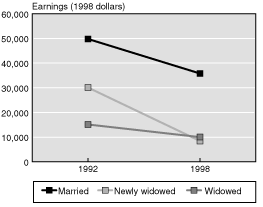
Family earnings in 1992 and 1998 among these three groups of women in the HRS are plotted in Chart ane. Boilerplate earnings decline for all three groups over this menstruum, partly considering families in the HRS are retiring during this menstruum. Mean family earnings for continuously married households declined past about thirty percent, from $50,000 to $35,000, and by a similar percentage for households with existing widows, from about $15,000 to $10,000. Not surprisingly, the drib in household family earnings for new widows was much more dramatic, with earnings falling by more than 300 pct, from near $30,000 to less than $x,000.
Chart 1.
Changes in mean family earnings of HRS women from 1992 to 1998, by marital status
SOURCE: Authors' calculations using data from the first wave of the Health and Retirement Study in 1992 (baseline) and the total sample of the HRS in 1998 (see Data section in text for description).
NOTES: The nautical chart is limited to women from the HRS but, because virtually families of women in the Alee sample were already retired at the start of the survey menstruum. The women surveyed were between the ages of 51 and 61 in 1992.
Married = married continuously throughout the interval; newly widowed = became a widow during the interval; widowed = widowed continuously throughout the interval.
Changes in household Social Security benefits for the same groups are shown in Nautical chart ii, for the HRS and the Ahead report. The patterns among the AHEAD accomplice in the bottom panel of Chart two reverberate perfectly the rules of the Social Security organization, in which benefits are based on lifetime earnings and accommodate past formula after widowhood. New widows in the AHEAD report had well-nigh the aforementioned benefits as those of married women in 1993, suggesting that new widows had like lifetime incomes. Following a husband's decease, widow benefits volition in general range from 67 percent of the married level, assuming the spousal benefit was equal to half that of the primary earner, down to 50 percent replacement in the example in which both partners had equal benefits based on earnings. New widows averaged about $10,000 per year in benefits in 1998 compared with just over $fifteen,000 when married (1993), indicating that nearly all of them had benefits that were based on their husband's earnings record. Continuously married and continuously widowed households showed substantially no change. Since poverty thresholds are based on equivalence scales for family size, this aligning in benefits contributes lilliputian to differences in poverty rates.
Chart two
Changes in Social Security benefits of HRS women and Alee women, by marital status
SOURCE: Authors' calculations using information from the start moving ridge of the Wellness and Retirement Study in 1992 (baseline) or the first wave of the written report of Asset and Health Dynamics Amongst the Oldest Old (Ahead) in 1993 (baseline) and the full sample of the HRS in 1998 (run across Data section in text for clarification).
Note: The women in the HRS were between the ages of 51 and 61 in 1992; women in the AHEAD report in 1993 were over 70.
In the HRS accomplice, the patterns are primarily determined past who claims benefits and who does not (Chart ii, top panel). The median age of the HRS accomplice, which ranged in historic period from 51 to 61 in 1992, was just 56 in 1998, then none of the cohort was eligible to claim benefits in 1992 and roughly half the cohort was not eligible to claim retirement benefits in 1998. Women in families receiving benefits in 1992 were thus married to older men. Families of new widows were more than likely to be receiving benefits while married in 1992, because their husbands were older and partly considering their husbands may take been more likely to collect early retirement benefits (at age 62) on the basis of poorer health. After widowhood, these new widows had higher average benefits than they did at baseline, because many of them became eligible to merits benefits between 1992 and 1998. Continuously married women experienced the greatest growth in mean benefits received, because they were less likely than the others to be receiving benefits in 1992 and because they were entitled to higher benefits when claimed.
Income from pension and annuities, illustrated in Nautical chart iii, drops for new widows in the HRS and the AHEAD study. In contrast, existing widows and continuously married women both were the beneficiaries of increased alimony and annuity income in the HRS and Ahead. This growth for stable marriages and standing widows in the AHEAD study suggests that some of the income may be based on funds whose payout depends on disinterestedness values, which improved over this time flow. In both studies, the gap betwixt new widows and the continuously married in 1998 was on the order of $5,000 per twelvemonth. It is somewhat surprising that pension income among new widows in HRS should reject, because many men had not still claimed alimony income. Information technology appears, nonetheless, that amid married men at baseline, those who would eventually exit a widow were more likely to accept taken early retirement, possibly because of poor health, and in both cohorts pension benefits were reduced afterwards decease.
Chart iii
Changes in pension and annuity income of HRS women and AHEAD women, by marital condition
SOURCE: Authors' calculations using data from the showtime wave of the Health and Retirement Written report in 1992 (baseline) or the first moving ridge of the report of Asset and Health Dynamics Among the Oldest Quondam (AHEAD) in 1993 (baseline) and the full sample of the HRS in 1998 (see Data department in text for description).
Note: The women in the HRS were between the ages of 51 and 61 in 1992; women in the AHEAD study in 1993 were over 70.
These steep declines in pension income for new widows may be surprising given the ERISA and REA reforms that crave both spouses' signatures to claim alimony benefits on a unmarried-life annuity. However, joint-and-survivor annuities that provide simply 50 per centum of survivor benefits are a common default plan that does not require the potential survivor's signature. Thus, while total loss of alimony benefits later on a husband'southward decease has get uncommon, total memory is likewise rare.
Considering of the relative loss in income amongst new widows, those women might be expected to draw down on their wealth at a faster rate than others.2 This would be especially truthful among nonelderly new widows who are likewise young to get Social Security benefits. The class of median net worth for women in the HRS (aged 51 to 61) and AHEAD report (aged lxx or older), is shown in Nautical chart 4, top panel and bottom panel, respectively. Women who are about to go widowed start out with lower levels of wealth compared with women whose marriages will continue, which is consequent with recent findings in Zick and Holden (2000). In both cohorts, standing widows fabricated essentially no gains during a boom market, while continually married women showed further increases in wealth. In addition to new widows drawing down wealth more rapidly, this divergence in net worth betwixt married women and widows also reflects the fact that a smaller portion of the assets of widows are held either directly or indirectly in equities. The principal contrast between new widows in the two historic period groups is the difference in cyberspace worth: new widows in the HRS lost enough wealth to fall near to the level of continuing widows by 1998; new widows in the Ahead written report posted gains in net worth. I possible explanation of this pattern is that younger widows (anile 51 to 61) consume their assets at a greater charge per unit because they are not yet eligible for Social Security.
Chart four
Changes in median net worth of HRS women and AHEAD women, by marital status
SOURCE: Authors' calculations using data from the starting time wave of the Health and Retirement Written report in 1992 (baseline) or the offset moving ridge of the study of Nugget and Health Dynamics Among the Oldest One-time (AHEAD) in 1993 (baseline) and the total sample of the HRS in 1998 (run across Data section in text for clarification).
NOTE: The women in the HRS were between the ages of 51 and 61 in 1992; women in the AHEAD study in 1993 were over 70
This comparison of income and assets between continuing wives, continuing widows, and new widows shows relative declines afterward widowhood for several components of income. In the HRS, family earnings for preretirement new widows reject faster than they exercise for women whose husbands remain live (Chart ane). Pension and annuity income declines for younger (aged 51 to 61) and older (aged lxx or older) new widows (Chart 3). Social Security benefits increment at a slower charge per unit for young new widows than for other women (married women or existing widows), perhaps because husbands of new widows were more likely to have claimed early benefits (Chart 2, top panel). Amid older existing widows, in that location are no changes in Social Security that would increase poverty (Nautical chart 2, bottom console).
Duration Furnishings on Widow Poverty
The comparison of the positions of new widows, standing widows, and married women between baseline (1992HRS, 1993AHEAD) and 1998HRS suggests that the economic condition of widows and married women may diverge with the elapsing of widowhood. The net worth of women widowed at baseline grows at a much slower rate than that of married women (Chart 4);3 pension and annuity income among continuing widows also increases at a slower rate than information technology does amid married women (Charts iv and five), and the women who were widowed early (before baseline as opposed to since baseline) are worst off financially across all measures.
Elapsing of widowhood could be related to economic status in a number of ways. Beginning, if a couple has not adequately planned for widowhood, the economic status of the widow may decline with the length of time that she is widowed. Second, widows may make economic adjustments, such every bit reentering the workforce, selling a home, or living with others, which may meliorate their economic status over time. Tertiary, duration effects could reflect selection into widowhood.
Those who take been widowed longest are more likely to have become widowed at a younger age. The well-documented correlation between wealth and health (Smith 1999) is one of the mechanisms driving the choice of women into widowhood. Poorer husbands have a lower life expectancy than exercise their wealthier peers; women married to poorer men will thus be widowed at an earlier age and will make upward a disproportionate share of widows and specially of long-duration widows. Lower baseline levels of wealth of new and existing widows, in 1992 and 1993, in Chart 4 are consistent with this selection. In this section we examine further the evidence of widow duration on poverty rates.
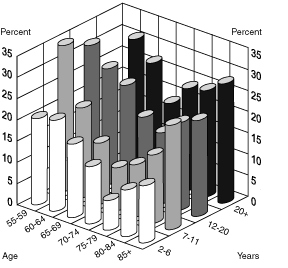
The Health and Retirement Written report obtains retrospective marital history information from all respondents at baseline, with which the date when women most recently became widowed, and thus the length of time they have been widowed, can be calculated for all widows present in 1998. Poverty rates amongst widows vary past age and by elapsing of widowhood (Nautical chart 5). A U-shaped design emerges when analyzing the effects of age: poverty rates are high for widows under the historic period of 65, substantially lower for widows aged 65 to well-nigh 80, and then loftier again amidst the oldest quondam. In general, elapsing effects portray more of a J-shaped pattern: starting high at very short durations, dropping lower for the next 10 years, and so rising quickly at longer durations. The short durations are problematic (see also Burkhauser and others 1986). By the nature of the HRS interview, income earned by the deceased married man will not be reported, even if he was alive for part of the preceding calendar year, and some of these women take not all the same received the adjustments to Social Security or pension survivor benefits that volition somewhen raise their incomes.
Chart 5
Poverty rates of widows, by age and elapsing of widowhood
SOURCE: Authors' calculations using data from the first wave of the Wellness and Retirement Written report in 1992 (baseline) and the full sample of the HRS in 1998 (run across Information section in text for description).
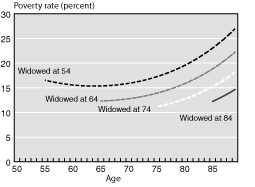
The statistical association betwixt poverty and duration of widowhood is articulate, excluding short durations: the greater the elapsing, the greater the take a chance of being in poverty. In an analysis of variance, the duration categories explain well-nigh twice every bit much of the variance as do the age categories. Regression assay can be used to generate synthetic profiles of the risk of poverty as a role of age and duration. The predicted probability of poverty is obtained by regressing whether or not a adult female is in poverty on the categories of age at and elapsing of widowhood. The false profiles in Chart vi, estimated from a single cross section and not from true longitudinal observations, suggest that more than than 15 percent of women widowed at the age of 54, earlier they are eligible for Social Security retirement income, will be in poverty upon the death of their husband. Poverty rates of widows decline initially, up to about the age of 65, most likely because of the receipt of Social Security benefits, and then rates increase systematically as widows age, with poverty rates of 20 percent or higher occurring in one case they attain their 80s. Women widowed at the historic period of 64 or 74 accept lower initial poverty rates, simply their economic position deteriorates steadily as well. At any given age, the women who had been widowed longest (that is, at the youngest ages) had the higher poverty rates.
Nautical chart half dozen.
Predicted probability of poverty of widows, past age at widowhood and duration of widowhood
SOURCE: Authors' calculations using data from the cross-sectional HRS total sample in 1998.
Notation: Regression assay is used to generate synthetic profiles of the risk of poverty equally a function of age and duration. The predicted probability of poverty is obtained by regressing whether or not a woman is in poverty on age at widowhood and elapsing of widowhood.
One manner in which widows at any historic period can compensate for reduced economic condition is to live with other family members. Non much is known most the allocation of resource within such multigenerational households. The poverty scales assume that income is pooled and treat coresident family members every bit a single economical unit. In Chart seven, changes in other-person income are followed for the three marital transition groups: continuously married women, new widows, and standing widows. Continuously married women have very little other-person (nonspousal) income. In HRS, their average level declines over time because of the departure of immature developed children from some households (Nautical chart seven, top console). Existing widows at baseline, however, had much higher levels. In HRS and Ahead, newly widowed women increased their other-person income by nigh $one,500. By 1998, they had essentially more than than continuously married women but still less than continuously widowed women (Chart 7). This could reverberate either a tiresome aligning process for new widows or a worse personal economic situation for women widowed earlier. In the HRS cohort, where the deviation betwixt new and continuing widows in 1998 was very big, it nearly certainly reflects lower personal resources of early widows who in the past moved in with other family members.
Chart vii
Changes in income of other family unit members of HRS women and Alee women, by marital status
SOURCE: Authors' calculations using data from the showtime wave of the Wellness and Retirement Study in 1992 (baseline) or the first wave of the study of Asset and Wellness Dynamics Among the Oldest Old (Alee) in 1993 (baseline) and the full sample of the HRS in 1998 (see Data section in text for description).
Annotation: The women in the HRS were between the ages of 51 and 61 in 1992; women in the Ahead study in 1993 were over 70
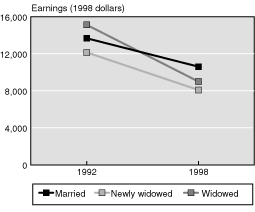
A second response mechanism is earnings from work, which is analyzed for the HRS cohort only in Charts 1 and 8. In Chart one, mean family earnings for the 3 marital transition groups turn down over time, every bit some of the cohort retires, but the decline for new widows is larger than it is for the others. From this chart, it is not clear how much of the refuse was due to lost husband's income and how much was due to changes in the woman'south earnings. In Nautical chart eight, the analysis of earnings information is for women only and shows that all women had earnings declines, with new widows consistently having lower earnings levels. By subtracting women'southward earnings from family earnings, the assay shows that at baseline the men whose marriages remained intact earned most $36,000, compared with just $18,000 for men who would leave behind a widow by 1998. Earnings response was therefore non a meaning factor in improving a widow's economical position, even in a cohort anile 57 to 67 at the end of the ascertainment period.
Chart viii
Changes in earnings from work of HRS women from 1992 to 1998, by marital condition
SOURCE: Authors' calculations using information from the first wave of the Health and Retirement Written report in 1992 (baseline) and the full sample of the HRS in 1998 (run into Data section in text for description).
NOTE: The women in the HRS were between the ages of 51 and 61 in 1992.
The potent statistical association between poverty and elapsing of widowhood could reflect any number of causal influences. Current age is exactly equal to age at widowhood plus duration of widowhood, and no statistical method tin can correctly identify the separate furnishings of all three. In Charts five and 6, which examine the relationship between duration and poverty by age, duration of widowhood is negatively correlated perfectly with age at widowhood. Women with the longest durations of widowhood were youngest when they became widows. Age at widowhood is likely to be important because of the life-cycle pattern of saving and dissaving for retirement and public programs. Beginning, losing a husband before retirement incurs a loss of potential future private savings, pension accrual, and Social Security benefit increases. Consumption must be supported for several or many years before pension or Social Security benefits brainstorm. In comparing, married women may exist well prepared for widowhood in after life. Second, the expiry of a spouse is often associated with high medical expenses, more of which may be out-of-pocket expenses when death occurs, before Medicare eligibility begins at the historic period of 65. For these cohorts, the date of widowhood may likewise affair, given the reforms of ERISA in 1974 and REA in 1984.
Duration of widowhood is a proxy too for the effects of several pick mechanisms that operate over time. Mortality rates are likely to be higher for poor women, leaving a smaller proportion of poor women as elapsing increases. Alternatively, if better-off widows are more than likely to remarry, then nosotros would await to find increasing poverty with duration of widowhood. In the amass, poverty and duration of widowhood are positively correlated. Still, some other machinery is likely to exist at play, considering remarriage pick is unlikely to dominate mortality pick. Among widows at moving ridge ane of HRS, 17 died and 6 remarried by wave 2. Among widows in AHEAD, 286 died and 8 remarried.
Duration of widowhood could also have a direct effect on item sources of income. Social Security, which is adjusted for inflation at the same rate as that of the poverty thresholds, should not be affected past duration of widowhood. However, individual pensions are not always indexed, and survivor benefits may non always be for the life of the widow, so it is possible that income from individual pensions decreases with duration of widowhood. Finally, if private savings are consumed too quickly early in widowhood, less nugget income will be bachelor afterwards in widowhood.
Crude descriptive evidence, so, indicates that current age and elapsing of widowhood are separately and independently related to poverty rates of widows. Because current historic period minus elapsing of widowhood equals the age at which widowhood began, we cannot infer from our information whether this design arises from true duration furnishings, such as overconsumption of assets, or from effects resulting from age at widowhood, such every bit greater shocks to lifetime income or stronger income-related selection effects at younger ages. The fact that the historic period profile of recent widows shows college poverty rates at younger ages suggests that a woman's age at widowhood may primarily be driving the effects past duration. This choice into widowhood is examined in the next section.
Pick Effects on Poverty Amid Widows
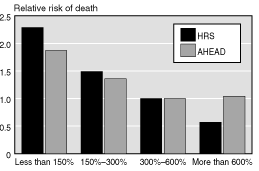
We offset look at the correlation betwixt bloodshed and socioeconomic condition and examine whether, having controlled for age, a husband's probability of death is correlated with income. Using married couples at baseline (1992 or 1993), we guess separate logistic regressions of the probability of a hubby'due south decease between baseline and 1998, every bit a function of the husband's historic period and of family unit income as a per centum of poverty. The relative chance of a husband's death varies equally a function of household income relative to the poverty line (Chart nine). The relative risks were computed separately for each cohort, thus neutralizing the much higher average death rate in the older cohorts. The younger HRS cohort shows a somewhat steeper and more regular path of declining mortality with higher income. Couples with income less than 150 percent of the poverty line were two.three times more probable than the reference group (300 percent to 600 percent of poverty) to experience a husband's expiry. The AHEAD cohort shows similar simply smaller differences by income: the group with income less than 150 percent of poverty was 1.8 times more likely to experience a hubby's death. The highest income group in the HRS experienced only 60 percent of the deaths that the reference group did; in Alee, substantially no difference was nowadays betwixt the acme group and the reference group.
Chart 9
Relative risk of husband'southward death, by family income as a pct of poverty
SOURCE: Authors' calculations using data from the start wave of the Health and Retirement Study in 1992 (baseline) or the outset moving ridge of the study of Asset and Health Dynamics Among the Oldest Old (Ahead) in 1993 (baseline) and the total sample of the HRS in 1998 (see Data section in text for description).
NOTE: Split up logistic regressions were estimated of the probability of a married man's decease between the corresponding baseline twelvemonth and 1998 as a office of the husband's age and family income as a percentage of poverty. The relative risks of death were computed separately for each cohort, thus neutralizing the much higher average death rate in the older cohorts.
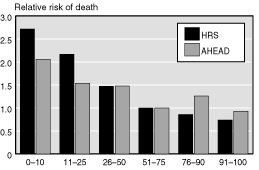
Because the income distributions differ betwixt HRS and Ahead, the logistic regressions were reestimated using percentile ranking in the cohort-specific income distribution instead of income relative to poverty. Much the same pattern is shown in Chart 10 as in Chart ix; however, the socioeconomic status gradient in HRS is steeper and steadier, compared with a shallower ane for Ahead. Beyond the median income, there is no clear benefit to college income for married men older than 70 in AHEAD.
Chart 10
Relative gamble of husband's death, by percentile ranking of family income
SOURCE: Authors' calculations using data from the starting time wave of the Health and Retirement Study in 1992 (baseline) or the first wave of the study of Asset and Health Dynamics Amidst the Oldest Old (AHEAD) in 1993 (baseline) and the full sample of the HRS in 1998 (come across Data section in text for description).
Annotation: Considering the income distributions differ between the HRS and the AHEAD study, logistic regressions were reestimated using percentile ranking of family income in the accomplice-specific income distribution.
The stronger the income-mortality gradient, the greater the selectivity of bloodshed. In the HRS, where couples near the poverty line have a greater relative risk of producing a widow than do couples in the older cohorts, new widows are expected to be disproportionately represented past women from households with few resource. That will still be truthful at older ages, simply less so. One factor relating age at widowhood to adventure of poverty, then, is the stronger association of income and mortality at younger ages. Poor men are more than likely to dice young than are other men, and hence young widows are more likely to come from poor households.
Strong show exists that poorer married women are more probable to become widowed over a given period. This assay thus examines the extent to which the poverty of widows is a continuation of marital poverty. Two classifications of economic status before widowhood are used: the poverty status of the wedlock in 1992 and the forecast in 1992 of the poverty status of widows. Forecasting future poverty requires data on the income of the potential widow. These data are obtained by combining information in the 1992 HRS on a variety of income sources (and whether they would continue if a hubby died) and on levels of wealth, while assuming that the widow will spend her wealth to allow a smooth consumption stream. The resulting mensurate is a consumption annuity that, like income, tin can be compared with the poverty threshold. The forecast measure out of the poverty status of widows is a proxy for how well a household has prepared for the risk of widowhood. A married woman in a household that is well higher up the poverty threshold tin withal be at high take chances of impoverishment when widowed, considering electric current poverty status reflects only current income and not income later on widowhood. If the household's income is dominated by the husband's earnings and the family does not have adequate life insurance and wealth, economic status while married may exist very different from economic status when widowed. Although poverty condition in 1992 and the 1992 forecast are non perfect predictors of future poverty (Table 3), both measures indicate that the economic resource of married women provide substantial information regarding their risk of poverty when widowed.
| Married women in 1992 | All widows in 1998 | Forecast in 1992 of poverty condition when widowed between 1992 and 1998 | |
|---|---|---|---|
| In poverty | Above poverty | ||
| All | 16.ii | 52.ii | eleven.four |
| Poverty condition | |||
| In poverty | 45.5 | 66.9 | 24.0 |
| Higher up poverty | 13.7 | 45.0 | ten.eight |
| SOURCE: Authors' calculations using data from the Health and Retirement Study. | |||
| NOTE: The sample consists of 247 widows in 1998 who were married and age-eligible in 1992. Analysis is done on HRS women only because AHEAD baseline information practice non let for authentic forecasts of future consumption annuities. The ages of women were between 51 and 61 in 1992. The forecast of poverty status in 1998 was based on an annuitization of wealth. | |||
In Table 3, which shows the actual poverty condition of women in the HRS who were married in 1992 merely widowed past 1998, according to the two classifications, 45.5 percent of married women in impoverished households remained impoverished when widowed, and 52.2 per centum of women that we forecast to be poor when widowed were indeed poor. Conversely, xiii.seven percent of women who were non in poverty in 1992 became impoverished upon widowhood, and 11.4 percent of women forecast to be above the poverty level were impoverished in 1998.
Combining baseline information on income (poverty status) and wealth (prospective-widow consumption annuities) provides slightly meliorate predictions of economical status when widowed. Two-thirds (66.9 percent) of women who were in poverty in 1992 and forecast to stay there if widowed were in poverty in 1998; the remaining roughly ane-3rd therefore managed to avoid that fate. Of the group of women who neither were in poverty in 1992 nor were forecast to fall into poverty, 10.eight percent became impoverished by 1998. Thus, although there is evidence of a strong persistence in poverty, widowhood results in a nontrivial incidence of new poverty as well. Selection of widows from poor households tin can account for much only not all of poverty amidst widows.
This comparison can exist sharpened with a multivariate logit showing the predictive effects of each poverty classification on the poverty of widows in the HRS, while controlling for the other. In Table four, results from four regression models are presented:
- model i, poverty status of married women in 1992;
- model 2, forecast of poverty status in 1998;
- model 3, poverty condition combined with the forecast measure; and
- model iv, inclusion of a dummy variable, widows anile 62 or older in 1998, to point eligibility for Social Security benefits.
| Variables | Model 1 | Model 2 | Model 3 | Model four | ||||
|---|---|---|---|---|---|---|---|---|
| Coefficient | Standard error | Coefficient | Standard fault | Coefficient | Standard error | Coefficient | Standard error | |
| Poverty in 1992 | 1.658 * | 0.497 | . . . | . . . | 0.933 | 0.572 | 1.116 | 0.616 |
| Forecast poverty | . . . | . . . | 2.141 * | 0.427 | 1.900 * | 0.454 | i.771 * | 0.472 |
| Aged 62 or older | . . . | . . . | . . . | . . . | . . . | . . . | -1.056 * | 0.387 |
| Constant | -1.837 * | 0.192 | -2.053 * | 0.213 | -ii.110 * | 0.219 | -1.548 * | 0.277 |
| N | 247 | 247 | 247 | 247 | ||||
| Pseudo R-sq | 0.0462 | 0.1103 | 0.1218 | 0.1569 | ||||
| Log likelihood | -104.405 | -97.393 | -96.130 | -92.291 | ||||
| SOURCE: Authors' calculations using information from the Wellness and Retirement Study. | ||||||||
| NOTES: The predictive effects of each poverty classification on widow poverty are analyzed, while controlling for the other: model 1, poverty status of married women in 1992; model two, forecast of poverty status in 1998; model 3, poverty status in 1992 combined with the forecast measure; and model 4, inclusion of a dummy variable, widows aged 62 or older in 1998, to indicate eligibility for Social Security benefits. . . . = non applicable. * Statistical significance is at the 1 percentage level. | ||||||||
Models i (poverty in 1992) and 2 (forecast poverty) kickoff compare the two classifications on their ain. Both are significant predictors of widow status. The forecast measure out, however, appears somewhat better, because it has a larger coefficient, smaller standard fault, and a better overall model fit (log likelihood). In Model 3, the bodily poverty status, when married in 1992, is not statistically pregnant as a predictor of the poverty of widows in 1998, when the forecast measure out is also included. Adding bodily poverty status of 1992 had a very small improvement of the model fit compared with Model 2, which had the forecast mensurate lone. The forecast mensurate incorporates most of the information from the actual poverty measure, plus additional data from wealth that is valuable in projecting poverty condition of widows. Finally, in Model iv, a dummy variable for whether the widow is 62 years of age or older in 1998 is added to indicate eligibility for Social Security benefits. Being older than 62 is associated with significantly lower rates of poverty for widows, indicating that Social Security eligibility relieves the fiscal strain for young widows.
As many other studies have shown, considerable motion in and out of poverty occurs over time for all types of households. Well-nigh half of poor married women remain poor when they become widowed, merely that as well means that more than half do not. Aging into eligibility for Social Security is an important factor eliminating poverty in this longitudinal accomplice study. Nevertheless, the persistence of poverty from marriage into widowhood, combined with the selectivity of poor women into widowhood, suggests that a big share of widow poverty reflects prior circumstances rather than specific costs associated with a husband's death. Moreover, the thirteen.7 percent incidence of widow poverty among nonpoor wives suggests that widowhood does increase poverty for some. To some extent, we can predict which women will become poor past looking at their baseline preparedness for widowhood. This analysis confirms that the in-depth measurement of income, assets, and claims to hereafter income undertaken by the HRS is relevant for documenting the resources of the well-off, and information technology besides adds significantly to the study of poverty.
Conclusion
In this article we found that duration of widowhood has a strong negative relationship with economical condition at any age. A substantial part of that human relationship is due to effects associated with a woman's historic period at widowhood. Women widowed in their 50s were more likely to take been poor before widowhood and suffered a greater loss of assets and pension income compared with women widowed after the age of 70. A substantial part of pension accrual and retirement savings occurs in the years but preceding retirement, so early widowhood prevents hereafter growth in resources besides. Social Security, which is so important in alleviating poverty for women widowed after the age of 65 and in protecting dependent children, is of relatively piffling help for women widowed in their 50s. Considering few have dependent children and they are well beneath the historic period of Social Security eligibility, they must expect many years before receiving any financial back up from Social Security.
Faced with the loss of resource in widowhood, women have only a few options bachelor to improve their economical status. Remarriage is difficult because of the demographic imbalances caused past the shorter life expectancy of men. There are too few instances of remarriages in the HRS to study its benefits. Living with children or siblings is some other way to be part of a household with more resource. This analysis found that widowhood was associated with an increase in the total income of other family unit members in the widow'southward household, equally one would wait. Earning income through work is the other main style women can improve their status, although that becomes increasingly difficult with age. Fifty-fifty for women in the younger HRS cohort, still, piddling evidence exists that the loss of a married man led to higher earnings past the adult female.
The Health and Retirement Report is a compelling source for studying the dynamics of poverty and widowhood. Because the HRS has such detailed information on wealth, health, and retrospective marital histories, they can be used to study more complex associations than other information sets have allowed. Fifty-fifty more important, the longitudinal perspective permits the report of the dynamics of poverty and the changes in economic condition that accompany a husband's expiry and the years that follow it.
The findings in this article provide a brighter outlook for widows than do earlier studies of widows in previous decades. In Table 5, poverty persistence and incidence rates are compared amongst women in the HRS with the rates of women in the Retirement History Survey of the 1970s. In the 1970s, 37 percent of new widows became poor later widowhood. Past the 1990s this charge per unit had fallen to between 12 percent and 15 pct.
| Written report flow | Continuously married | Newly widowed | Continuously widowed | |||
|---|---|---|---|---|---|---|
| Poor at offset | Not poor at first | Poor at offset | Non poor at outset | Poor at start | Non poor at start | |
| RHS 1973–1975 | 49 | 4 | 85 | 37 | l | 11 |
| HRS 1994–1998 | 30 | 3 | 43 | 15 | 44 | 7 |
| AHEAD 1995–1998 | 44 | 2 | 58 | 12 | 63 | 10 |
| SOURCE: Authors' calculations using data from the Wellness and Retirement Study, the study of Asset and Health Dynamics Among the Oldest Sometime, and from the Retirement History Survey from Hurd and Wise (1989, Table 6.3). | ||||||
Nevertheless, widowhood still remains an important risk cistron for transition into poverty. Social Security policy must remain attentive to the special situation of widows: women who are to the lowest degree able to prepare for widowhood are at greatest hazard of widowhood because of the relationship betwixt mortality and wealth. We would advise that boosted attending be paid to the welfare of women widowed later on their children accept grown merely before they accept completed their retirement preparations. Because these women are more often than not not eligible for Temporary Assistance for Needy Families, Supplemental Security Income, or Social Security, they are most vulnerable to poverty. Even women who accept some accumulated wealth are more likely to be in poverty many years later as they are forced to spend downwards their wealth in the years earlier Social Security eligibility.
Notes
i. Differences cannot be due to differential limerick by marital status, race, or age, considering the analytic weights of the Health and Retirement Written report (HRS) are poststratified to friction match the Electric current Population Survey.
2. Widowhood also increases the optimal rate at which wealth should be fatigued down, because a widow is only concerned with single survivorship and married couples are concerned with articulation survivorship.
iii. This may be due to consumption out of wealth, or to differences in portfolio allotment, and, correspondingly, to differences in rates of return.
References
Bound, John; Greg J. Duncan; Deborah S. Laren; and Lewis Oleinick. 1991. "Poverty Dynamics in Widowhood." Periodical of Gerontology: Social Sciences 46(3): S115–S124.
Burkhauser, Richard V. 1994. "Protecting the Well-nigh Vulnerable: A Proposal to Improve Social Security Insurance for Older Women." The Gerontologist 34(2): 148—149.
Burkhauser, Richard V.; Karen C. Holden; and Daniel A. Myers. 1986. "Marital Disruption and Poverty: The Role of Survey Procedures in Artificially Creating Poverty." Demography 23(four): 621–631.
Holden, Karen C., and Sean Nicholson. 1998. "Selection of a Articulation-and-Survivor Pension." Word Paper No. 1175-98. Madison, WI: Institute for Research on Poverty.
Hurd, Michael D., and David A. Wise. 1989. "The Wealth and Poverty of Widows: Assets Earlier and After the Husband's Death." In The Economic science of Crumbling, edited by David A. Wise, 177–199. National Bureau of Economic Inquiry projection report. Chicago: University of Chicago Press.
McGarry, Kathleen. 1995. "Measurement Error and Poverty Rates of Widows." Periodical of Human being Resources 30(1): 113–134.
Sandell, Steven H., and Howard Chiliad. Iams. 1997. "Reducing Women'due south Poverty by Shifting Social Security Benefits from Retired Couples to Widows." Journal of Policy Analysis and Direction 16(two): 279–297.
Smith, James P. 1999. "Healthy Bodies and Thick Wallets: The Dual Relation Between Health and Economical Status." Journal of Economical Perspectives thirteen(2): 145–166.
Weir, David, and Robert Willis. 2000. "Prospects for Widow Poverty in the Finances of Married Couples in the HRS." In Forecasting Retirement Needs and Retirement Wealth, edited past Olivia Southward. Mitchell, P. Brett Hammond, and Anna M. Rappaport, 208–234. Philadelphia: University of Pennsylvania Press.
Zick, Cathleen, and Ken Smith. 1991. "Patterns of Economic Change Surrounding the Expiry of a Spouse." Journal of Gerontology: Social Sciences 46(6): S310–S320.
Zick, Cathleen D., and Karen Holden. 2000. "An Cess of the Wealth Holdings of Contempo Widows." Journals of Gerontology Series B: Psychological Sciences and Social Sciences 55: S90–S97.
Source: https://www.ssa.gov/policy/docs/ssb/v65n3/v65n3p31.html
0 Response to "impoverished spouse when spouse dies what happens to that income"
إرسال تعليق